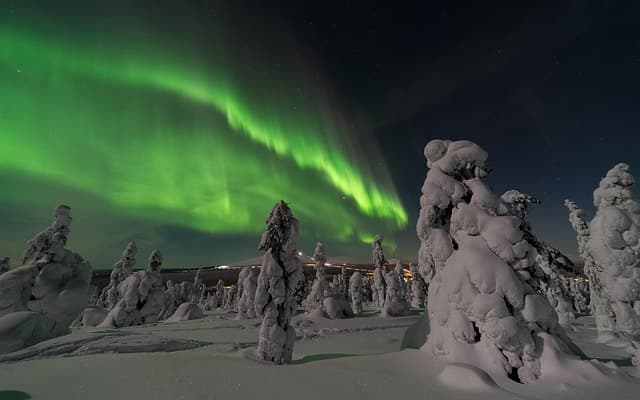
The Northern Lights are one of the most mesmerizing natural phenomena, but to see them, it is important to choose the right time and place.
Sami mythology gives the Northern Lights (Finnish: revontulet, Latin: aurora borealis) a special mystical meaning. For the Sami, this phenomenon is associated with ancestral spirits, magic, and even taboos.
This is not surprising, as the Northern Lights are one of the most breathtaking natural phenomena that can be observed in the northern sky, although this celestial spectacle can only be seen under certain conditions. Below, we will tell you when and where it is best to observe the Northern Lights in Finland.
Although the Northern Lights can occur all year round, they can only be seen from the ground during the dark hours of the day when the sky is clear. The Northern Lights season lasts from September to April, especially during the autumn and spring equinoxes. During this period, the Earth’s magnetic field helps direct solar particles toward the poles, creating spectacular light shows.
At the end of winter (February–March), the probability of seeing the aurora is higher, as cloud cover becomes less dense. However, it is best to avoid nights with a full moon, as its light can reduce the visibility of the aurora.
The brightest and most frequent auroral displays are observed in Lapland, closer to the Arctic Circle. In the Kilpisjärvi region, the northern lights can be seen on three out of four nights! In the Kolari–Sodankylä areas, it appears every other night—provided the sky remains clear.
Cloudless weather plays a key role in successfully “hunting” for the northern lights. Even if the sky is cloudy, a camera with a long exposure can capture the aurora, which is invisible to the naked eye. Use satellite and weather maps to track cloud movement, and hills and high ground will help you find clearer skies. To increase your chances, get as far away as possible from city lights, which create interference.
The northern lights follow the rhythm of the day and are most often seen around midnight. However, they can appear as early as 6 p.m. and delight the eye until the early morning, so it’s worth staying outside and watching the sky for several hours.
Yes, but this is rare. At times, the aurora does appear over the Finnish capital, especially during strong magnetic storms. To catch this moment, keep an eye on the forecasts and choose locations away from city lights.
When planning your aurora expedition, remember:
- Dark and clear skies;
- Northern regions of Finland;
- Patience and a good camera.